
What Is Electrical Insulation Resin?
A practical technical guide to rigid polyurethane systems, elastic polybutadiene-based resins, silicone gel insulation, potting, encapsulation, cable joints and service-friendly electrical protection.
Electrical insulation resin is a two-component chemical system used to protect electrical and electronic components against moisture, water, dust, vibration, mechanical stress and environmental exposure.
However, not all insulation resins behave the same way. Depending on the formulation, the cured material may become rigid, elastic, removable or gel-like. This difference is critical when selecting the right material for cable joints, junction boxes, potting applications or serviceable electrical connections.
Why Electrical Insulation Resin Is Used
Electrical connections are often exposed to harsh conditions. Moisture, temperature changes, dust, mechanical vibration and field installation errors may reduce long-term reliability. A properly selected insulation resin helps protect the connection area and improve service life.
- Cable joints and connection points
- Electrical junction boxes
- Potting of electronic components
- Encapsulation of sensors, motors and technical parts
- Moisture and water protection
- Field insulation applications
Rigid Electrical Insulation Resins
Rigid polyurethane or epoxy-based insulation systems form a hard protective structure after curing. This type of system is typically selected when the application requires permanent protection, mechanical stability and strong environmental sealing.
The rigid structure is mainly related to the crosslink density of the cured system. Higher crosslink density usually results in better mechanical strength, but it also makes re-entry and maintenance more difficult.
Rigid systems are preferred when:
- The connection does not need to be reopened
- Mechanical support is required
- Permanent potting or encapsulation is needed
- Water and moisture resistance is critical
- The protected area is not expected to be serviced frequently
Elastic and Removable Electrical Insulation Systems
In some applications, permanent hard potting is not the best solution. Service teams may need to reopen the connection, take probe measurements or inspect the cable joint without destroying the entire insulation mass.
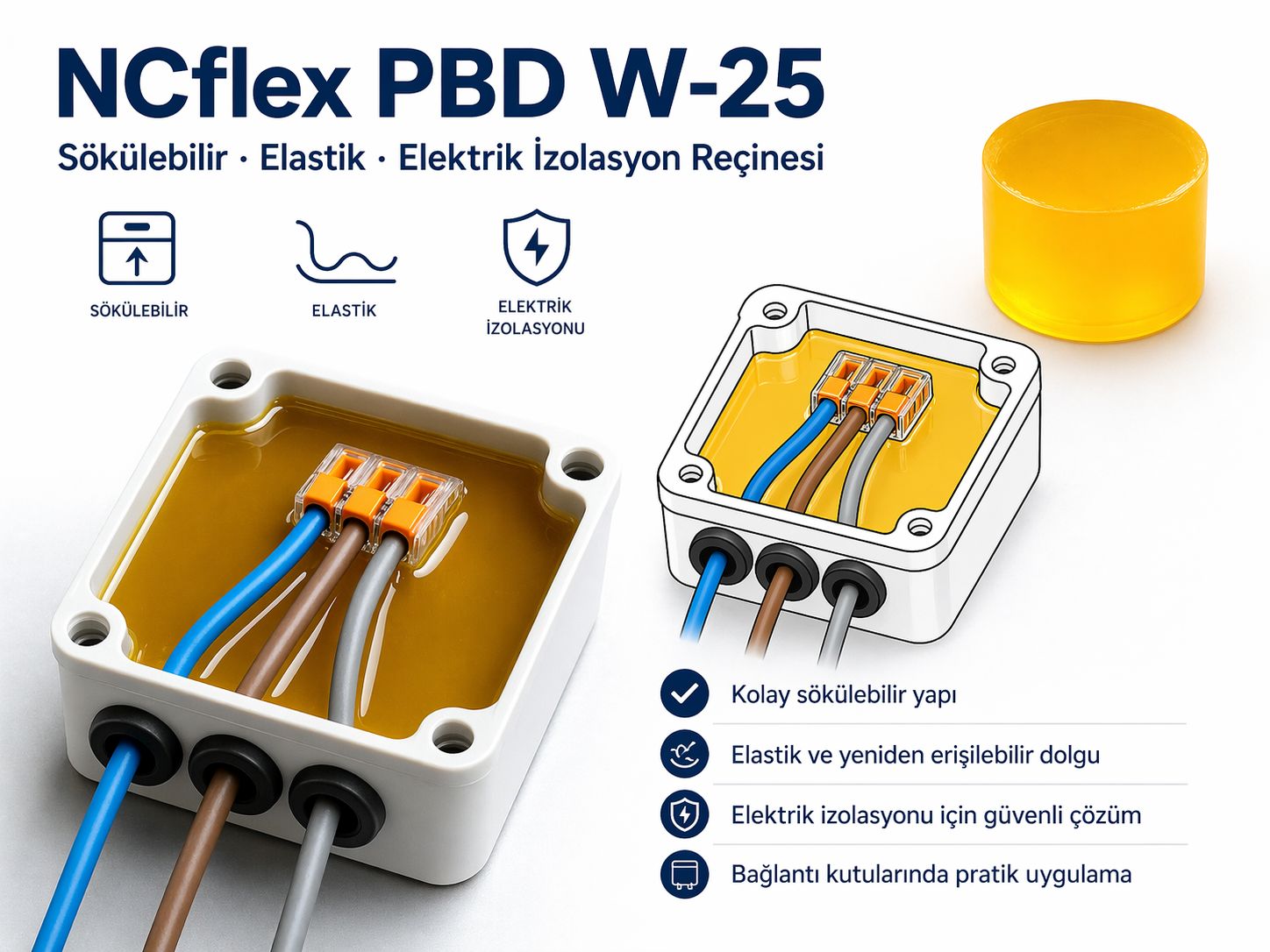
This is where elastic and removable systems become important. NCflex PBD W-25 is a polybutadiene-based, re-enterable electrical insulation resin designed for applications where flexibility, maintenance access and electrical protection are required together.
Instead of forming a brittle hard casting, NCflex PBD W-25 forms a soft, elastic and removable gel-like structure after curing. This makes it suitable for service-oriented electrical insulation applications.
Elastic systems are useful when:
- Maintenance access is required
- Probe measurement may be needed
- The cable or connection may move slightly
- Thermal expansion must be tolerated
- The connection should remain protected but accessible
Technical Note
Polybutadiene-based systems can provide flexible behavior due to their low glass transition temperature and elastomeric backbone. This makes them useful where rigid potting may create stress, cracking risk or service limitations.
Silicone Gel Electrical Insulation Systems
Silicone gel systems are generally softer and more flexible than rigid polyurethane systems. They can provide a low-modulus protective mass around electrical connections and may offer advantages where transparency, flexibility and easy re-entry are desired.
NCgel is developed as a transparent silicone-based electrical insulation gel system for junction boxes, serviceable connections and practical field applications.
Silicone gel systems may be preferred when:
- Visual inspection is important
- A soft gel structure is required
- Low mechanical stress around components is desired
- The connection may need to be reopened
- Moisture protection is required in junction boxes
Potting vs Encapsulation
Potting means completely filling a housing, box or enclosure with resin. The component becomes embedded inside the cured system. This is commonly used for strong mechanical and environmental protection.
Encapsulation is a more controlled protection approach where the component is covered or surrounded by a protective material, but the system may not always be fully filled or permanently locked.
Rigid systems are often preferred for permanent potting, while elastic or gel systems may be better for applications requiring future service, inspection or re-entry.
Comparison: Rigid, Elastic and Silicone Gel Systems
| Criteria | Rigid Resin | Elastic Resin | Silicone Gel |
|---|---|---|---|
| Final structure | Hard / rigid | Elastic / removable | Soft / transparent gel |
| Service access | Limited | Good | Good |
| Mechanical support | High | Medium / flexible | Low / soft |
| Typical use | Permanent potting | Re-enterable insulation | Junction box gel protection |
| Example Protolin system | Protolin standard polyurethane systems | NCflex PBD W-25 | NCgel |
How to Choose the Right Electrical Insulation Resin
The correct resin should be selected according to the final application, not only according to price or hardness. Service access, operating temperature, cable movement, moisture exposure and installation method should all be considered.
- For permanent protection: choose a rigid polyurethane or epoxy-based system.
- For re-enterable service applications: choose an elastic removable system such as NCflex PBD W-25.
- For transparent gel protection: choose a silicone gel system such as NCgel.
- For clean field application: evaluate dual-component pouch packaging and practical application formats.
Protolin System Approach
Protolin does not evaluate resin formulation and packaging as separate topics. In real field applications, the packaging format, mixing method, reaction behavior, viscosity, curing profile and final mechanical structure all affect the user experience.
This is why Protolin focuses on both material development and practical application systems such as NCpack dual-component packaging, NCflex removable insulation and NCgel silicone gel protection.
Application-Oriented Engineering
A technically correct insulation resin should not only perform in a laboratory. It should also be practical to mix, easy to apply, suitable for the field environment and aligned with the real service needs of the user.
Conclusion
Electrical insulation resin selection is not simply a question of “hard or soft.” The correct choice depends on the application geometry, service requirement, environmental exposure, mechanical movement and expected lifetime of the protected connection.
Rigid systems provide permanent protection. Elastic polybutadiene-based systems provide removable and service-friendly insulation. Silicone gel systems provide soft, transparent and flexible protection for junction boxes and re-enterable applications.
For removable and re-enterable gel insulation applications, visit our NCflex & NCgel Electrical Insulation Gel Systems page.
For general resin solutions, visit our Electrical Insulation Resins page.